Mindfulness

Your Body Is Seasonal: Growth Happens at the Speed of Safety

There’s a quiet pressure woven into our culture that tells us we should always be moving forward.

More productive.
More motivated.
More disciplined.
More consistent.

And when we’re not, when energy dips, when rest is needed, when things slow down, it’s easy to assume something is wrong.

But what if nothing is wrong?

What if your body isn’t failing you…

What if it’s moving exactly as it’s meant to?

Your Body Is Not Linear

We are often taught to measure progress in straight lines.

Start here. Improve steadily. Reach the goal.

But your body doesn’t operate that way.

Your body is seasonal.

There are times of energy and outward movement.
Times of rest and restoration.
Times of processing and integration.
Times when things feel quiet, even stagnant.

And none of those phases are mistakes.

They are part of a natural rhythm that prioritizes safety over speed.

Growth Happens at the Speed of Safety

Your nervous system has one primary job:

To keep you safe.

Not productive.
Not efficient.
Not impressive.

Safe.

When your body perceives safety, energy becomes available for growth, creativity, connection, and expansion.

When your body perceives stress or overwhelm, it shifts into protection.

Energy is redirected.
Capacity changes.
Motivation often disappears.

Not because you’re lazy.

But because your system is doing exactly what it’s designed to do.

Growth doesn’t happen through force.

It happens when the body feels safe enough to expand.

Listening Instead of Pushing

Many of us have learned to override our bodies.

To push through fatigue.
To ignore tension.
To treat rest as something we have to earn.

But the more we override, the more disconnected we become.

And eventually, the body gets louder.

Burnout.
Exhaustion.
Irritability.
Brain fog.
Loss of motivation.

These aren’t failures.

They are communication.

Your body is asking for a different pace.

Capacity Over Motivation

We often wait for motivation to return before we take action.

But motivation is unreliable when the nervous system is overwhelmed.

Capacity is the more honest measure.

Capacity asks:

What is actually available to me today?

Not what should be.
Not what it used to be.
Not what someone else can do.

Just what is real, right now.

Some days, capacity is high. Other days, it’s limited.

Both are valid.

Working with your capacity instead of against it creates sustainability.

And sustainability is what allows growth to last.

Gentle Living as a Practice

Gentle living isn’t about doing nothing.

It’s about doing what’s aligned with your current state.

It’s choosing:

  • A shorter walk instead of an intense workout

  • A quiet evening instead of forcing social energy

  • One meaningful task instead of ten rushed ones

It’s adjusting your expectations to match your nervous system, not fighting against it.

And over time, this builds something powerful.

Trust.

Rebuilding Trust With Your Body

When you begin to listen instead of override, something shifts.

Your body starts to feel safer.

And when it feels safer, it becomes more willing to open.

  • Energy returns more consistently.

  • Focus improves.

  • Creativity comes back online.

Not because you forced it.

But because you created the conditions for it.

This is body wisdom.

Not something you have to learn from outside sources.

Something you remember by paying attention.

You Are Allowed to Move Like the Seasons

There will be times when you feel expansive, energized, and ready to take on more.

And there will be times when you feel slower, quieter, more inward.

You don’t have to judge either phase.

You don’t have to rush out of one into the other.

You are allowed to move like the seasons.

  • To rest without guilt.

  • To grow without pressure.

  • To pause without panic.

Because nothing in nature blooms all year.

And neither do you.

Reflection

Take a moment to check in with yourself:

  • What season does my body feel like it’s in right now?

  • What would it look like to honor that instead of resist it?

You don’t have to change anything immediately.

Just notice.

That’s where safety begins.
You’re Not Behind: Gratitude for Your Pace, Not Someone Else’s Timeline

There’s a quiet pressure many people carry that rarely gets spoken out loud.

The feeling of being behind.

Behind in healing.
Behind in success.
Behind in clarity, confidence, relationships, finances, purpose.

Behind compared to friends.
Behind compared to strangers online.
Behind compared to who you thought you’d be by now.

That pressure can sit heavily in the chest. It can make rest feel irresponsible. It can turn growth into a race.

But here is something gentle and true:

You are not behind.

Comparison Disconnects You From Self-Trust

Comparison is subtle. It doesn’t always sound loud or jealous. Sometimes it sounds like motivation.

“I should be further by now.”
“They figured it out faster.”
“I need to catch up.”

But the moment you measure your timeline against someone else’s, you disconnect from your own body’s rhythm. You override your capacity. You stop listening.

Growth does not happen on a universal schedule.

It happens at the pace your nervous system can safely handle.

If your body has lived through stress, trauma, burnout, illness, or simply years of overextending, it will not unfold at the same speed as someone who hasn’t. That is not weakness. That is biology.

Healing happens at the speed of safety.

Growth That Happens Quietly Still Counts

Some growth announces itself. Promotions. Certifications. Milestones. Public declarations.

But much of the most meaningful growth happens internally.

Choosing not to respond the way you used to.
Resting when you would have pushed.
Saying no when you once would have said yes.
Catching a critical thought and softening it.

No one applauds those moments. They don’t show up on highlight reels.

But they matter.

The quiet growth that happens inside your nervous system is often the foundation that makes sustainable change possible. Roots grow underground long before anyone sees a bloom.

If you feel stalled, consider this:

What if you’re not stuck?
What if you’re stabilizing?

Trust Is Built Through Small, Kept Promises

Self-trust doesn’t come from dramatic reinventions.

It grows from small promises kept consistently.

Drinking water when you said you would.
Closing your laptop when you planned to.
Going to bed at the time you committed to.
Taking a walk when your body asked for movement.

Each small follow-through tells your system: I am safe with myself.

This is where discipline transforms.

Discipline does not have to mean punishment or intensity. It can mean devotion. It can mean creating structures that support you instead of shaming you.

Kind discipline sounds like:

“I will do what supports me.”
“I will not demand more than I can give.”
“I will honor my limits.”

That builds trust.

Honoring Subtle Progress

When you feel behind, it’s often because you’re only measuring visible progress.

But subtle progress may look like:

Less anxiety than last year.
More awareness than before.
Better boundaries.
A softer inner voice.
A quicker return to regulation after stress.

These are not flashy accomplishments. They are signs of nervous-system-led growth.

They are evidence that you are not stagnant.

You are integrating.

You are stabilizing.

You are learning to move forward without abandoning yourself.

Gratitude for Your Pace

Gratitude for your pace does not mean complacency.

It means respect.

It means recognizing that rushing yourself rarely produces sustainable change. It means trusting that what feels slow may actually be protective.

You are allowed to grow gradually.

You are allowed to take breaks.

You are allowed to move at the speed that keeps you intact.

You are not late. You are unfolding.

And unfolding takes time.

Reflection

Take a quiet moment and ask yourself:

  • Where am I rushing myself unnecessarily?

  • What promise can I realistically keep to myself this week?

Start there.

Not with intensity.
Not with comparison.
Just with one steady step.

That is enough.

Gratitude Without Pretending: Letting Go of Toxic Positivity

There’s a version of gratitude that feels light and freeing.

And then there’s the version that feels forced.

If you’ve ever been told to “just be grateful,” to “look on the bright side,” or to remember that “everything happens for a reason” while you were still hurting, you know the difference.

Gratitude is powerful. But when it becomes something we perform instead of something we feel, it stops being healing.

What Toxic Positivity Actually Looks Like

Toxic positivity doesn’t usually sound cruel. It often sounds spiritual. Encouraging. Optimistic.

It sounds like:

  • “At least it made you stronger.”

  • “Other people have it worse.”

  • “You just need to focus on the positive.”

  • “Choose gratitude.”

The problem is not gratitude itself. The problem is bypassing reality.

When someone is grieving, exhausted, angry, or overwhelmed, pushing them to “just be grateful” can quietly communicate that their feelings are inconvenient. It suggests that pain is a mindset problem instead of a valid human experience.

In wellness spaces especially, positivity can become a badge of honor. We’re rewarded for being calm, regulated, inspired, and grateful. We’re less comfortable sitting with raw truth.

But healing doesn’t happen through denial. It happens through safety.

The Difference Between Gratitude and Spiritual Bypassing

Spiritual bypassing is when we use spiritual language or concepts to avoid uncomfortable emotions.

It can look like:

  • Reframing trauma before it’s processed

  • Forcing forgiveness before anger is acknowledged

  • Claiming everything is “divinely timed” while ignoring harm

  • Pretending something doesn’t hurt because you want to seem evolved

Real gratitude does not erase pain. It does not skip over grief. It does not require you to package your experience into a lesson before you’re ready.

Gratitude, in its healthiest form, is an acknowledgment. It says: this is hard, and I’m recognizing my strength within it.

It allows for both truths:
This hurt.
And I survived.

That’s very different from:
This hurt, but I shouldn’t feel bad about it.

Why Honest Gratitude Supports Nervous System Safety

Your nervous system is wired for truth.

When you pretend you’re fine, your body knows you’re not. When you push yourself into positivity while you’re still activated or grieving, your system stays on alert. There’s a subtle internal conflict between what you’re saying and what you’re feeling.

Honest gratitude removes that conflict.

It sounds like:

  • “This is painful, and I’m doing my best.”

  • “I don’t like this, but I can see my resilience.”

  • “I’m struggling, and I’m still here.”

When you name what’s hard without trying to fix it, your body softens. There is relief in being allowed to tell the truth.

Gratitude becomes grounding instead of performative.

You Don’t Have to Perform Healing

You don’t have to rush to silver linings.

You don’t have to turn every hardship into a growth story.

You don’t have to convince yourself you’re grateful before you actually feel it.

It’s okay to say:

  • I’m angry.

  • I’m tired.

  • This is unfair.

  • I don’t understand why this happened.

And later, when it feels real, you might also say:

  • I’m proud of how I handled that.

  • I’m grateful I didn’t give up.

  • I’m stronger than I realized.

Both can exist.

Gratitude without pretending allows your healing to be honest. It allows your growth to be earned, not performed.

You can be grateful without being fake.
You can be healing without being positive.
You can be strong without minimizing what you endured.

That is real resilience.

Reflection

Take a moment to pause and check in.

  • What feels hard right now?

  • What strength helped you carry it?

You don’t have to change anything about the answer.

Just notice.

That noticing is enough. 🌿

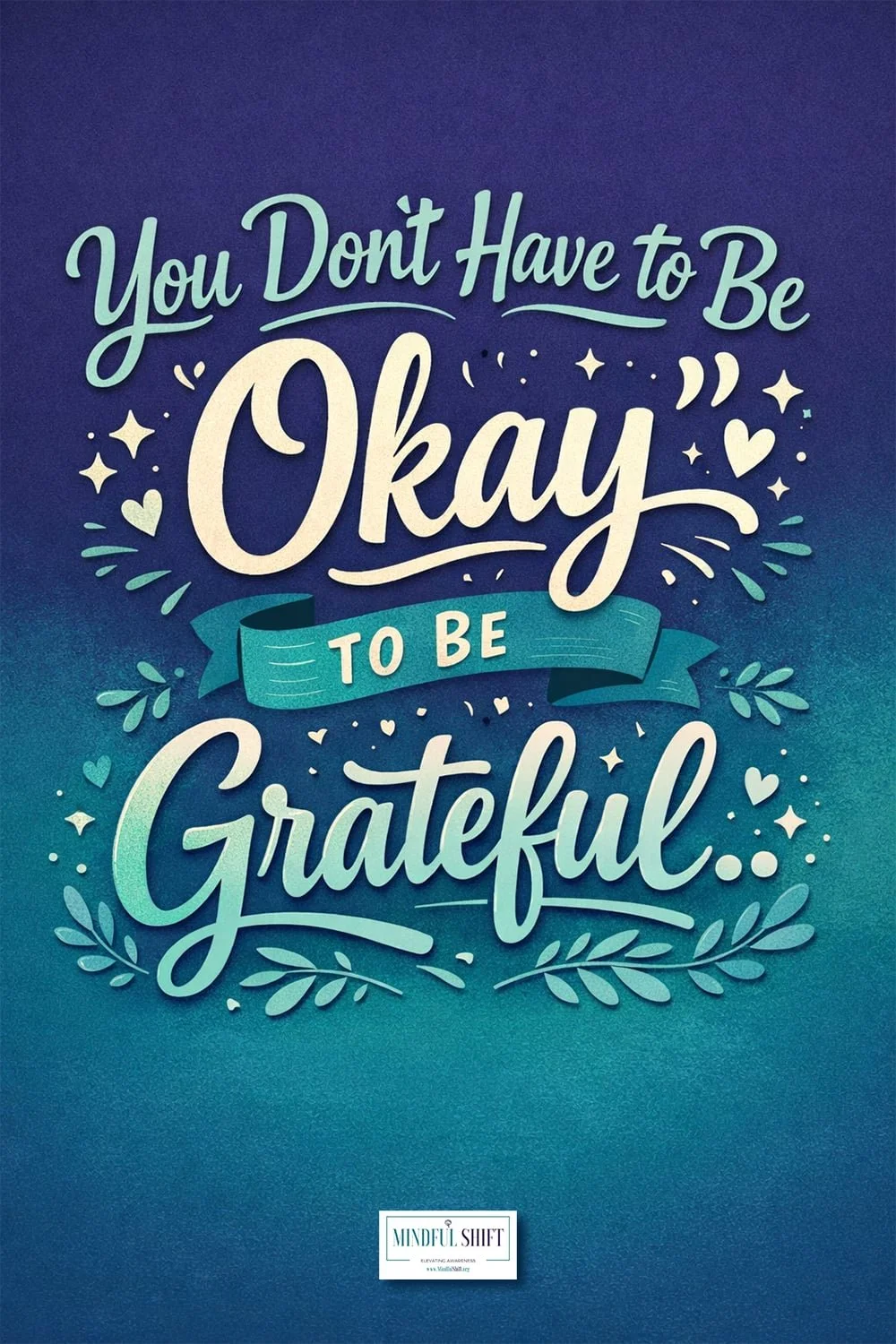
• You Don’t Have to Be “Okay” to Be Grateful

There’s a version of gratitude that gets passed around a lot. The kind that says everything happens for a reason, that insists you should be thankful because someone else has it worse, that quietly asks you to hurry up and feel better.

This isn’t that kind of gratitude.

The gratitude we’re practicing here doesn’t require you to like what you went through, or to pretend the pain shaped you into something shiny and resolved. This kind of gratitude simply acknowledges the truth: you survived something that once felt impossible.

You’re still here.

Gratitude, in this sense, is not approval. It’s an acknowledgment. It says, “This was hard, and I carried it anyway.” It honors the version of you who kept going when quitting would have made sense. The version that learned how to breathe through things they never imagined they’d have to hold.

So often, we’re taught that gratitude should erase grief, anger, or exhaustion. But real gratitude doesn’t cancel those feelings. It sits beside them. Life can be both painful and meaningful. You can still be healing while recognizing your strength.

If you’re comparing your timeline to someone else’s, it’s easy to miss how far you’ve come. Growth doesn’t always look like milestones or big transformations. Sometimes it looks like quieter things: better boundaries, softer self-talk, learning when to rest, choosing yourself in small but consistent ways.

You don’t have to be “okay” to be grateful. You don’t have to be finished. You don’t have to make meaning out of everything you endured.

You’re allowed to simply say: I’m still here, and that matters.

Reflection

  • What did you survive that once felt impossible?

  • What version of you deserves gratitude today?

How Finding Your Purpose Can Make You Happy

There’s a quote by Dr. Albert Schweitzer that’s worth pondering:

“The purpose of human life is to serve, and to show compassion and the will to help others. “

Think about this for a minute. Finding your purpose becomes a lot easier when you think about it in these terms. What skills and traits do you have that could help others? How could you build your life, your job, or your business around those skills?

But what does all that have to do with making you happy? Taking the time to figure out how you can help others and then doing just that is a powerful thing. We are social creatures and hardwired to help our community. When we make it a daily goal to do just that it’s an incredibly rewarding experience.

Yes, part of it is because we’ll be thanked or recognized for what we’re doing, but that’s only a small part of it. To be perfectly honest, doing good will make you happy even when no one else knows about it. There’s an internal reward built in. We feel good about ourselves. Our self-worth grows and with it our self-esteem.

Or think about it this way. What would make you feel better? Going about your day shuffling papers, answering the phone and putting in the time required at your desk without much to show for at the end of the day? Or would you feel more fulfilled and happier if you knew without a shadow of a doubt that you made a difference in someone’s life today? What if that paperwork you did helped a family find a better place to live? What if those calls you made ensured that a little girl doesn’t go to bed hungry tonight. What if that class you taught helps a young mom stay home with her baby and still contribute to the family income? What if you found your purpose – whatever it may be – and made a real difference in someone’s life with what you do? Wouldn’t that make you feel happier? Wouldn’t that give you a sense of accomplishment?

Spend a little time to figure out what you can do to help those around you. Think about what you could do to serve others and make a difference in their lives. In other words, spend a little time figuring out what your purpose in life is and how it can impact the people whose lives you touch – be it in person, through a book or via the internet. That’s the beauty of the day and age we live in. We can reach and make a difference in the lives of people across the globe.

Stop making excuses and find your purpose, and with it your own happiness.

5 Good Reasons to Find Your Why

5 Good Reasons To Find Your “Why”

There are quite a few reasons to find your “why”, your reason for getting up in the morning and doing what you do. Finding your purpose can be a powerful thing and it goes well beyond the satisfaction of knowing you’re doing something worthwhile. Let’s take a look at five different good reasons to spend the time to find your “why”.

You’ll Feel Less Stressed

How much mental energy and worry do you spend trying to figure out what you should or could be doing each day? When your “why” is clear in your mind, you don’t have to worry about that any longer and feel less stressed.

But there’s more to it than that. When we aren’t following our passion and purpose, we aren’t happy with what we’re doing and with that comes added stress. It’s no wonder that you’ll feel calmer and more relaxed about what you do and life in general when you know where you’re going.

You’ll Get More Done

Time flies when you’re having fun and it slows down to a crawl when you aren’t. Along the same lines you get a lot more productive and get through your workload in a lot less time when you have a purpose and are passionate about what you’re doing.

I’m sure you’ve noticed this in your daily life. When you’re working on something you enjoy or something that’s important to you, the work almost seems to do itself. You don’t even notice how long or how hard you’ve been at it.

You Do A Better Job

Not only do you get things done faster, you do everything you can to learn more and get better at what you love to do. As a result you do a much better job. Now there’s a great reason to find your why and follow your purpose.

You’ll Feel Better About Yourself

There’s nothing better to lift your mood and boost your self-esteem than doing some good. Don’t be surprised to notice quite a bit of this once you figure out what your purpose in life is and then do what you’re meant to be doing, helping those in need.

You’ll Be Happier

All of this leads to one all-important end result. You’ll be happier. You’ll be more fulfilled with what you do and live a more content life. And isn’t that something we’re all striving towards. Who knew the secret to lifelong happiness was to find your “why”.

Recognizing Your Own Fears – and Overcoming Them

You may not recognize your own fears and simply see them as uncomfortable feelings of inadequacy. Only when you can recognize them for what they are and put a name to them will you be able to plot against them and finally overcome them.

Fear turns to anxiety and together they can wreak havoc on your goals and dreams for the future. Symptoms of fear and anxiety may be pronounced - such as a rise in blood pressure or heart rate.

Your breathing patterns may change and you may feel like you want to run rather than face your fears. Others may experience a paralyzed feeling and take no action at all. Procrastination is a result and you may never overcome it, depending on how fearful we are and how much we’re willing to fight it.

Simply the anticipation of problems or a bad ending to a situation can cause symptoms of fear and cause us to drop out emotionally and physically of wherever we were heading when fear stopped us in our tracks.

You don’t have to accept fear and let it rule your life. Face it head on with true facts rather than the negative scenarios you let run through your mind when facing the unknown.

Once you know your fears for what they are, you can find a solution to move past it. You take control rather than fear controlling you. You’re no longer the victim, but an empowered and self-confident person who invites positivity rather than negativity into your life.

After you’re able to recognize the signs and symptoms of your fears, you’ll be better able to empower yourself, face the fears and trust that you can overcome the fears and be on your way to achieving your dreams and goals.

It’s easier to empower yourself when you have a plan. Set mini goals for yourself when you’re afraid of the outcome of a situation. Each time you reach one of those small goals you’re further on your way to realizing the end result – and with each small step you’re knocking down the building blocks of fear.

Fear makes you settle for less than you can be. You may settle for a job that pays less than you’re worth simply because of fear preventing you from thinking of yourself as worth it.

Settling for a relationship that doesn’t really work is also based on fear – fear that you’ll never be able to have the relationship you want because you don’t deserve it. Overcome those fears by thinking about what steps you’d take if you did deserve happiness - both in a relationship and your life’s work. Think of the amazing things that could happen in your life if you could just stop being afraid. Begin to unmask the fears and see them for what they really are – lies.

Dare Yourself to Overcome Fear of Success

Why does the thought of success strike fear in so many people with so much potential? The answer could be because there’s change involved. Simply put, most of us are afraid of any changes that are going to shake us out of the cages which have become our comfort zone.

If you’re going to be successful, you’re going to have to overcome the fear and take action. You can begin the journey by daring yourself, setting aside your fears and taking action to meet your goals for the future.

Fear is normal – fear of snakes, heights, drowning, rejection – and the changes that come with success. Fear is a normal part of life, but unless you address those fears, they will follow you around, make you miserable and squash any dreams of success you may have.

You may feel you’re not good enough for success or perhaps you’re afraid you’ll fail and people will discover you’re a fraud. It may be time to dare yourself to success – because you have the power and the strength within you to take the necessary actions to meet your goals and make your dreams come true.

It’s okay to feel that fear in your mind and heart. The danger is letting that fear paralyze you into taking no action at all. Acknowledge that you are fearful and know that it’s normal.

Then, it’s time to face those fears and figure out what you have to do to make success happen. Begin small and with each step, dare yourself to think bigger and better. Eventually, you will have dared yourself to success.

Maya Angelou once said, “I believe the most important single thing, beyond discipline and creativity is daring to dare.” When you dare to take control of your life and take action to make those dreams come true, the fear will gradually begin to wane and then you’ll forget about it altogether.

Take a moment to think about what you would do – which actions you would take – if you weren’t afraid. Write those actions down and one by one dare yourself to make them happen.

Tap in on the brave side of your personality and use the power you have to add more power and overcome the obstacles one by one until you make success happen. Ask for guidance if needed.

Take courses, read books or network with successful people – anything to give you the knowledge and confidence you’ll need to overcome the fears. When you make a conscious decision to dare yourself and take the actions needed to reach success, you’re on your way to dashing all your fears that you’re not good enough, not creative or beautiful enough and other negative thoughts that hold you back.

Think of all the challenges that bring fear into your heart and mind and then dare yourself to overcome them. Begin small and your fears of success will diminish as you go along.

Calm Your Fears with Careful Planning


Calm Your Fears with Careful Planning

You’d never climb Mount Everest without a careful plan outlining in detail the best route to get there. But many of us run helter-skelter into unknown areas when attempting to reach our goals without any planning at all.

 We simply know that there’s an opportunity that we might want to do and begin the trek regardless of the obstacles that are sure to arise and that we know nothing about. Stress and anxiety can arise and overwhelm even the strongest of desires for success.

 If you know ahead of time what the triggers are that could cause stress and anxiety, you’ll be better able to combat them with a careful plan – arming yourself to overcome any negatives that come your way.

There are several ways to plan ahead and alleviate any fears you may have regarding a situation. Pre-planning before an event where you have to give a speech keeps you from rushing at the last minute to gather knowledge about what you’re going to say and how you’re going to say it.

It’s not all mindset that can get you through your fears – sometimes the body and mind rebel against the food you’re ingesting or lack of exercise to keep your body fit and your mind sharp.

Caffeine, alcohol and chemicals found in most foods (especially fast foods) can wreak havoc with your moods and make your mind fuzzy. Before an event or situation you’re fearful about, make sure you stay hydrated by drinking lots of water, getting plenty of vitamins B, C and E to boost the effectiveness of your nervous system and never eating a huge meal just before an event.

Your overall health may also trigger fears and anxiety. Try to get as much sleep as possible just before an event, eat well-balanced meals and exercise – even if it’s only some stretches or deep breathing.

Meditation may also help calm any fears you have about a particularly stressful or anxious situation. Affirmations during meditation can boost your self-confidence as you think about how you’ve handled situations successfully before.

It’s sometimes those things that are most fearful to you that can lead you to realize success and fulfill your dreams. For example, if the career path you’ve chosen means you have to speak in public and the thought leaves you anxious and stressed out, you’ll want to take steps to alleviate that fear.

You could take courses, engage a mentor or strive to discover other tips and advice on how to get over the fear. Remember that you don’t have to be perfect at anything you want to try.

Perfectionism can lead to the irrational fear that everyone notices when you make a mistake or take a wrong turn. In reality, no one cares and it’s doubtful than anyone even noticed.

Careful planning was imperative to NASA’s goal of achieving successful trips to the moon – and careful planning can serve to alleviate your fears and help you realize all your goals and dreams for the future, too!